

EU Leads Edible Nuts Market to USD 34.23 Billion by 2036, Driven by Olam, ADM & Blue Diamond Growth Strategies
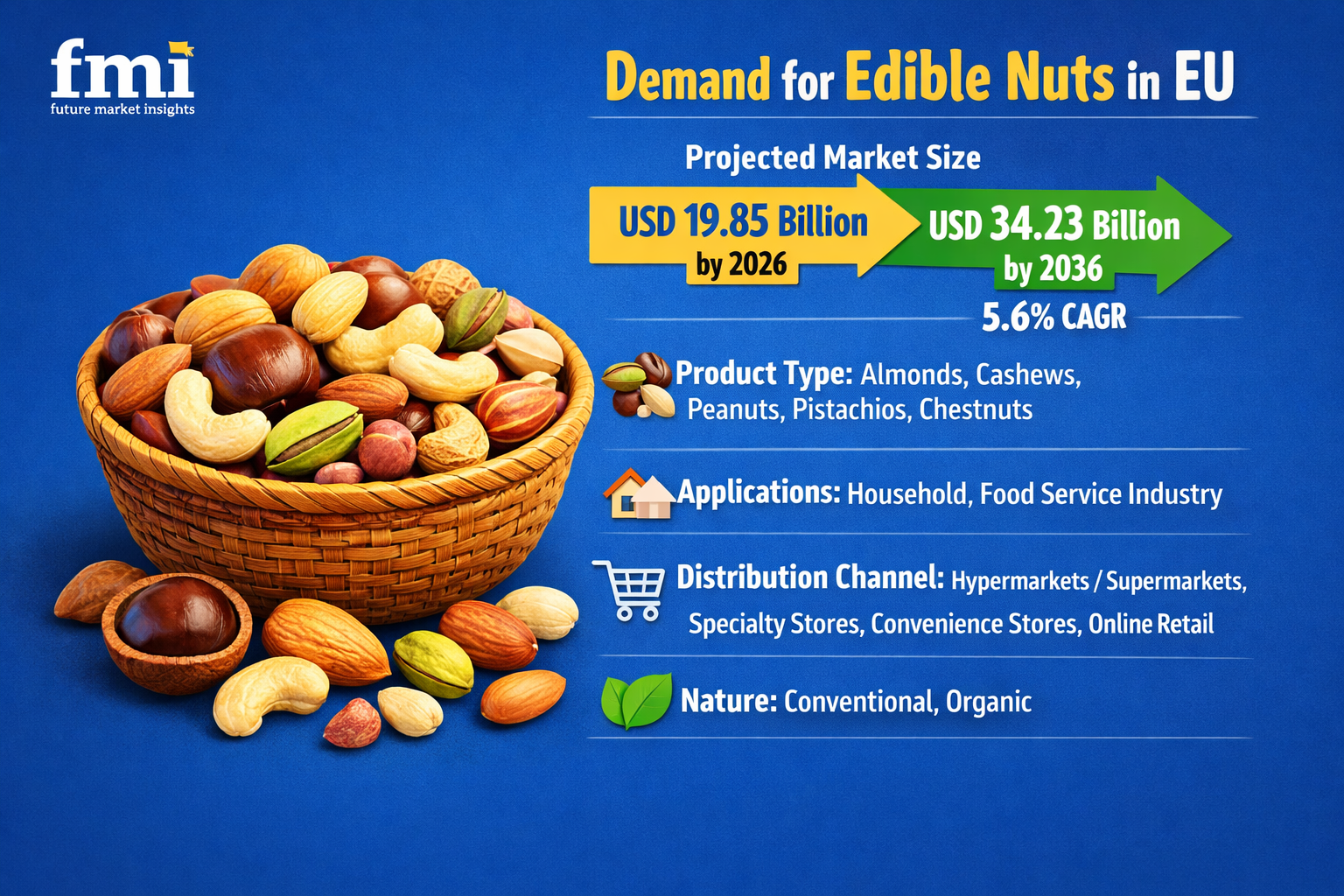
Demand for Edible Nuts in EU
EU edible nuts demand grows with plant-based diets, premium snacking trends, and strong global players driving innovation and supply expansion.
NEWARK, DE, UNITED STATES, March 31, 2026 /EINPresswire.com/ -- According to analysis by Future Market Insights (FMI), the demand for edible nuts in the EU is entering a phase of sustained expansion as protein-rich snacking trends, plant-based food innovation, and format premiumization collectively reshape consumption patterns, pricing dynamics, and competitive positioning.
Rising consumer preference for nutrient-dense, clean-label snacks, combined with increasing adoption of plant-based diets, is transforming edible nuts from traditional pantry staples into high-value, multi-functional food ingredients. At the same time, premium formats such as single-serve packs, flavored variants, and organic-certified nuts are enhancing value perception and driving per-unit price growth across retail channels.
The market was valued at USD 6.97 billion in 2025 and is projected to reach USD 19.85 billion in 2026. Over the forecast period, demand is expected to grow at a CAGR of 5.6%, ultimately reaching USD 34.23 billion by 2036.
This growth trajectory reflects both expanding consumption volumes across snacking and foodservice applications, as well as increasing average selling prices driven by branding, processing, and origin-based differentiation.
Get Access of Report Sample: https://www.futuremarketinsights.com/reports/sample/rep-gb-27146
Edible Nuts Market in EU Snapshot
• Market Value (2025): USD 6.97 Billion
• Forecast Value (2036): USD 34.23 Billion
• Forecast CAGR (2026–2036): 5.6%
• Leading Product Type: Almonds (30% share)
• Top Application Segment: Household (60% share)
• Fastest Growing Market: Netherlands
Premiumization and Protein Snacking Drive Market Expansion
A key force shaping the EU edible nuts market is the convergence of health-focused snacking and value-added processing. Consumers are increasingly shifting toward nuts as protein-rich alternatives to processed snacks, supported by favorable front-of-pack labeling systems and growing awareness of nutritional benefits.
Brands are leveraging format innovation—such as roasted, seasoned, and portion-controlled packaging—to transform commodity nuts into premium retail products. Additionally, origin-specific branding, including Marcona almonds, Bronte pistachios, and Piedmont hazelnuts, is strengthening product differentiation and pricing power.
Simultaneously, industrial demand from plant-based dairy and meat alternatives—including almond milk, cashew cheese, and nut-based spreads—is creating a parallel growth channel, intensifying competition for raw material supply.
Import Dependency and Supply Chain Complexity Shape Market Dynamics
The EU edible nuts market remains structurally dependent on imports, with regional production accounting for less than 30% of total consumption. Key suppliers include the United States for almonds, walnuts, and pistachios; Vietnam and India for cashews; and Turkey and Iran for hazelnuts and pistachios.
This import reliance exposes the market to supply-side risks, including climate variability, geopolitical disruptions, and trade policy changes. Additionally, stringent EU food safety regulations and rising sustainability certification requirements are adding complexity to procurement strategies.
As a result, companies securing diversified sourcing agreements and maintaining strong supplier networks are better positioned to ensure supply continuity and manage cost volatility.
Household Consumption Leads While Foodservice Gains Momentum
By application, household consumption is expected to account for 60% of the market in 2026, driven by the widespread use of nuts in home snacking, cooking, and baking.
Growth in this segment is supported by:
• Increasing preference for healthy, convenient snacks
• Expansion of resealable and multi-pack formats
• Integration of nuts into everyday recipes
Meanwhile, the foodservice segment is gaining traction as restaurants and food manufacturers expand nut usage in plant-based dishes, clean-label formulations, and premium menu offerings.
Almonds Lead Product Demand
By product type, almonds are projected to dominate the EU edible nuts market with a 30% share.
Their leadership is driven by:
• Versatility across snacking, dairy alternatives, and confectionery
• Strong nutritional profile, including high vitamin E content
• Established global supply chains ensuring availability
In addition, ongoing innovation in almond-based products—such as flavored snacks and plant-based beverages—is reinforcing their position as the preferred nut variety among European consumers.
Netherlands Emerges as Growth Leader in Europe
Regionally, the EU edible nuts market shows varied growth patterns across countries:
• Netherlands: 6.8% CAGR
• Spain: 6.3% CAGR
• Italy: 6.0% CAGR
• Rest of Europe: 5.7% CAGR
• Germany: 5.3% CAGR
• France: 5.1% CAGR
The Netherlands leads growth, supported by strong food innovation capabilities, advanced distribution infrastructure, and early adoption of plant-based diets. Spain and Italy benefit from domestic production and Mediterranean dietary traditions, while mature markets such as Germany and France exhibit steady, value-driven growth.
Sustainability and Value-Added Processing Unlock Opportunities
The market is increasingly shaped by advancements in sustainability and processing technologies. Key innovation areas include:
• Sustainable sourcing and traceability programs
• Flavoring, coating, and fortification technologies
• Premium packaging and portion control solutions
At the same time, companies are investing in allergen management systems and dedicated production facilities to balance expanding nut consumption with food safety requirements.
Competitive Landscape
Leading companies in the EU edible nuts market include:
• Olam International Ltd
• Archer Daniels Midland Company
• Blue Diamond Growers
• The Wonderful Company LLC
• Besana Group
• Borges Agricultural & Industrial Nuts
• Barry Callebaut Group
• Savencia SA
These players are focusing on integrated sourcing, processing innovation, sustainable practices, and brand development to strengthen their market position.
Market Outlook: Premiumization and Plant-Based Demand Sustain Growth
The long-term outlook for the EU edible nuts market remains positive, driven by increasing adoption of plant-forward diets, rising health awareness, and growing demand for high-quality, minimally processed foods.
However, the market will continue to face challenges related to import dependency, supply volatility, and allergen concerns, which may impact scalability and pricing dynamics.
As the category evolves, value creation will increasingly depend on format innovation, branding, and processing capabilities. Companies that successfully transform commodity nuts into differentiated, premium products will be best positioned to capture growth opportunities in the expanding EU market.
Browse More Reports from Food and Beverages:
Shrimp Market: https://www.futuremarketinsights.com/reports/shrimp-market
Demand for Frozen Egg in South Korea https://www.futuremarketinsights.com/reports/south-korea-frozen-egg-market
Vanilla Bean Market: https://www.futuremarketinsights.com/reports/vanilla-bean-market
Resveratrol Market: https://www.futuremarketinsights.com/reports/resveratrol-market
Sudip Saha
Future Market Insights Inc.
+ +1 347-918-3531
email us here
Legal Disclaimer:
EIN Presswire provides this news content "as is" without warranty of any kind. We do not accept any responsibility or liability for the accuracy, content, images, videos, licenses, completeness, legality, or reliability of the information contained in this article. If you have any complaints or copyright issues related to this article, kindly contact the author above.
